
STUART HIGHWAY FENCE
ALICE SPRINGS 2007
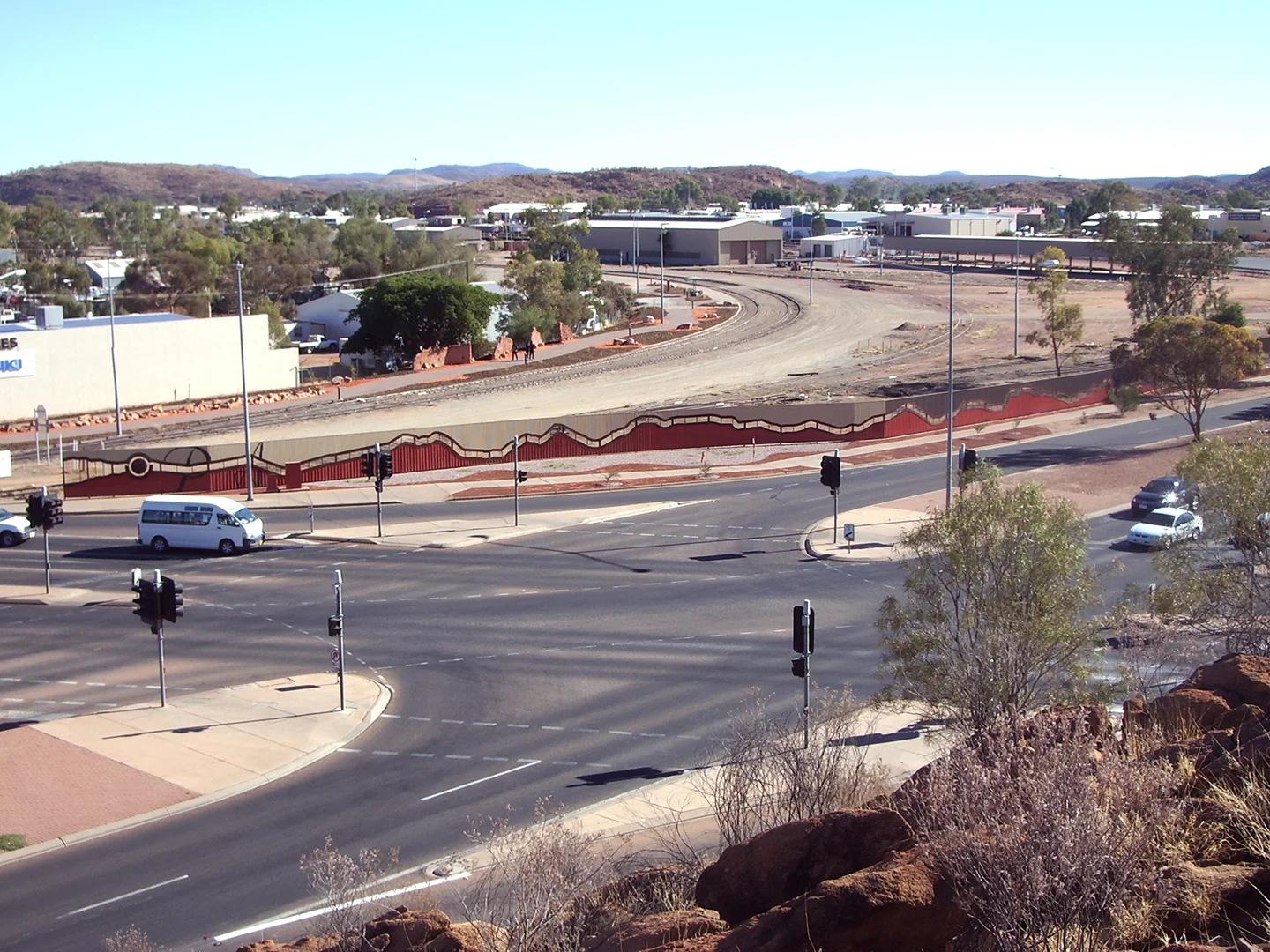
The Stuart Highway fence is an abstract representation of travel and movement, reflecting the function of the Stuart Highway and the railway line. The variable band in the fence is an abstract map, and is generated from a scan of a map of the Stuart Highway from Port Augusta to Darwin. It includes reference to the major towns and intersections along the highway in lettering that uses the cursive script of 19th century hand-annotated maps.
Travel, movement and transience are major aspects in the life of all cultures living in the region, historically and in the present. The fence encapsulates this iconic condition of the town: from early explorers to contemporary commercial transport, from the traditional Indigenous nomadic life to contemporary movement between remote communities and Alice Springs, from the transient young white population on one or two year employment contracts to the seasonal grey nomads, all have this condition in common.
Related concepts include the telegraph line erected to link Australia with the ‘rest of the world’, the Indigenous art of the region which is typically a cultural mapping of country, and Indigenous song lines forming maps through country and sustaining cultural memory.
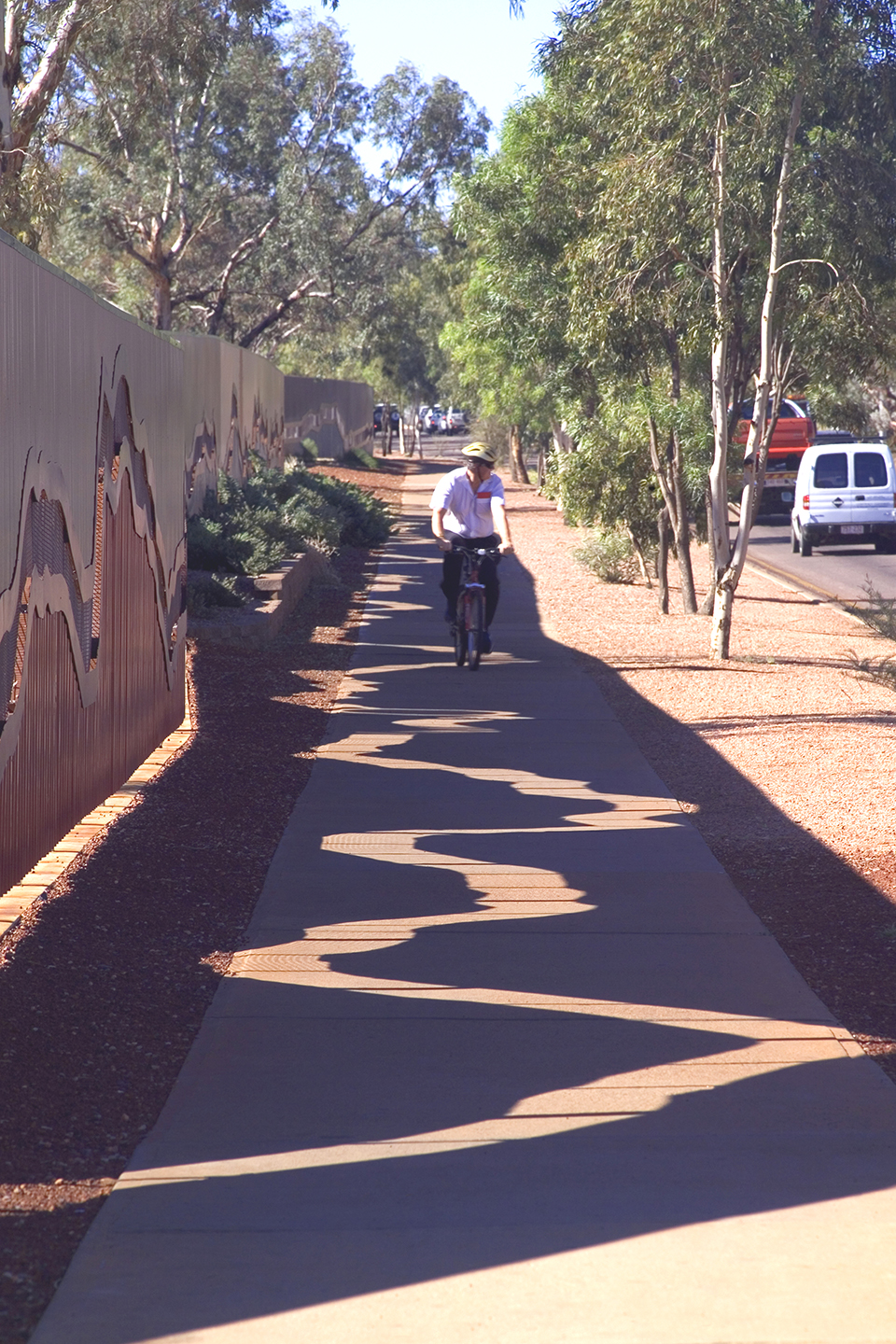
Physically, the fence is barely more than a 2 dimensional object. However, it has the compelling third dimension of time – the fence is only fully accessible with movement and therefore with the passage of time. The fence is designed to be viewed while moving, and gives the dynamic sensation that it is travelling with you as you move along the highway. It is experienced variably depending on your mode of travel. From a car the central band seems to leap and bounce along, from a bicycle it is a more fluid experience, and to a pedestrian it offers a human-scale horizon line, and a variable-height peep show to the view behind. From trains the monochrome rear of the fence appears as an integral part of the landscape.
The Alice Springs public has embraced the fence wholeheartedly. The public and cultural benefit of the fence is its’ broad appeal combined with a degree of abstraction that stimulates relationship and interpretation as a public art installation.
The fence forms an edge to the CDB of Alice Springs and is part of many residents and visitors’ everyday experience of the town. The highway and its’ pedestrian pathway is a main commuter route for motorists, cyclists and pedestrians. The fence can be glimpsed at the end of CBD cross streets and between buildings.
The fence is constructed from ‘off the shelf’ materials and components with robust finishes. As an all steel structure it will not be affected by the harsh environmental conditions including heat, cold, dryness and termites. The rusted steel bands and woven steel mesh are integral elements of the structural design.




AWARDS
2009 AIA NT CHAPTER URBAN DESIGN COMMENDATION
2009 AIA NT CHAPTER BLUESCOPE STEEL COMMENDATION